
In 2020, Michael Cavna from The Washington Post has posted a very insightful article about that final strip -- which it was its first quarter-century of existence. We all know that Watterson was against to selling on merchandising (Even the non-official merchs of his) his characters and universe, which he wanted to get 100% control of what he'll created for. Many comics series and cartoonists don't have the same chance, especially those from big book editors like in Europe, that work like corporate banking machines.
The article is seen below. Enjoy!
‘Calvin and Hobbes’ said goodbye 25 years ago. Here’s why Bill Watterson’s masterwork enchants us still.

“A new year...a fresh, clean start!” a joyous boy in red mittens said a quarter-century ago this week, shortly before soaring forth on the most famous sled in American arts this side of “Citizen Kane.” And just like that, the high-spirited 6-year-old and his best buddy were never seen again — at least not in new images.
Yet the beloved duo have never really left us.
“Calvin and Hobbes,” one of the greatest strips ever to grace newspapers, blazed across the pages for a beautiful decade before heading off into the white space of our imaginations, trusting us to continue the next adventures in our heads. And to this day, the creation — once syndicated to 2,000-plus papers — is ever-present on bestseller lists, in libraries and nested on home shelves within easy reach of nostalgic adults and each next generation of young readers.
Decades later, the brilliance of “Calvin and Hobbes” refuses to dim. It remains a tiger — the tiger — burning bright.
The final “Calvin and Hobbes” strip was fittingly published on a Sunday — Dec. 31, 1995 — the day of the week on which Bill Watterson could create on a large color-burst canvas of dynamic art and narrative possibility, harking back to great early newspaper comics like “Krazy Kat.” The cartoonist bid farewell knowing his strip was at its aesthetic pinnacle.
“It seemed a gesture of respect and gratitude toward my characters to leave them at top form,” Watterson wrote in his introduction to “The Complete Calvin and Hobbes” box-set collection. “I like to think that, now that I’m not recording everything they do, Calvin and Hobbes are out there having an even better time.”
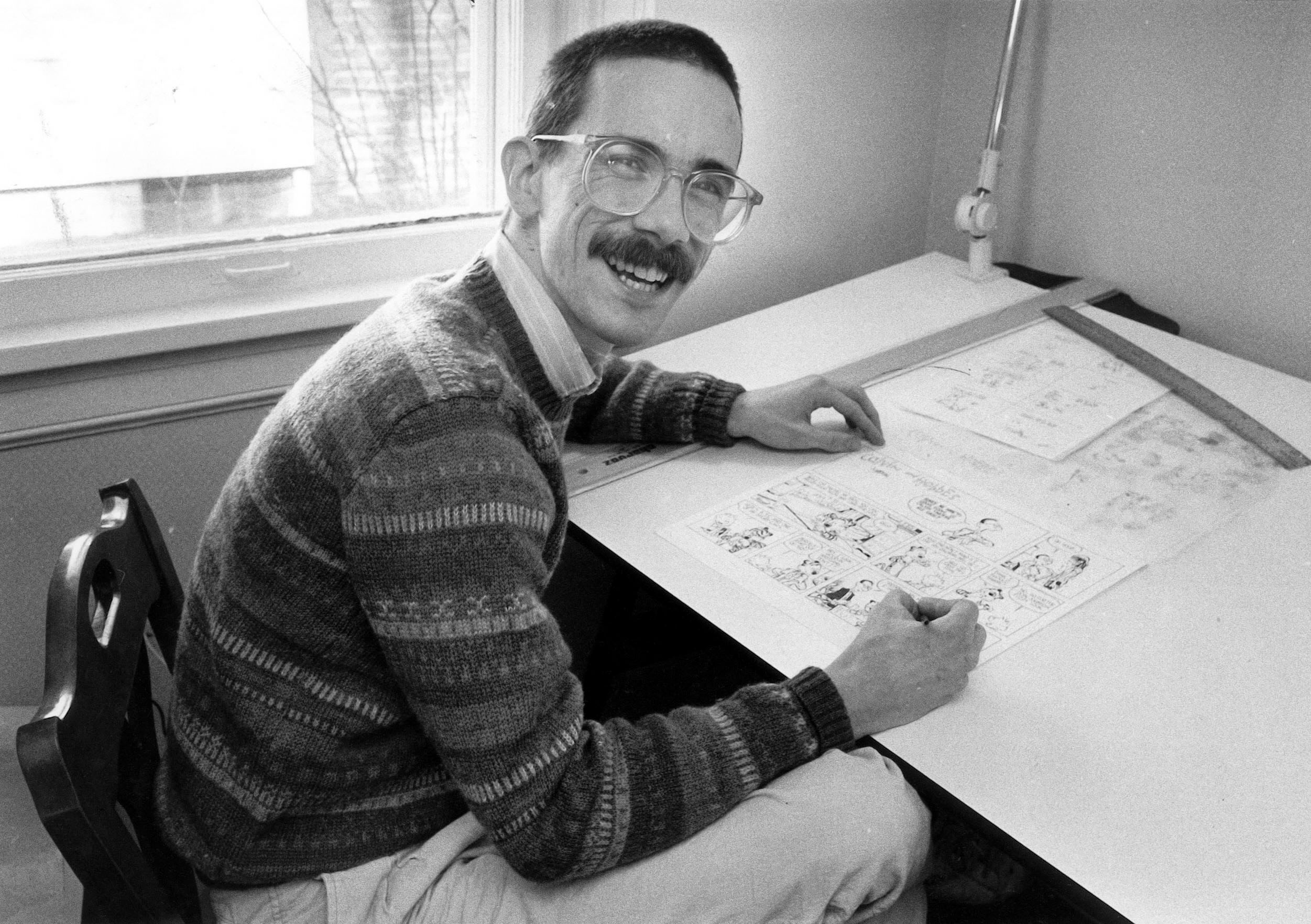
Readers return that respect. Ask a fan for a favorite “Calvin and Hobbes” scenario and a stream of recurring comic premises pours forth.
“Spaceman Spiff, Tracer Bullet, Calvinball, G.R.O.S.S., the wagon rides, Calvin’s battles with his food, Calvin’s epic confrontations with [babysitter] Rosalyn, the cardboard-box inventions, Stupendous Man — and that’s just off the top of my head,” says curator Andrew Farago, whose Cartoon Art Museum in San Francisco has exhibited Watterson’s original art. “I don’t think any strip since ‘Peanuts’ made such an impact on so many people.”
Just what is it about “Calvin and Hobbes” that continues to enchant so many?
For some fans and fellow artists, it begins with the comic’s sense of boundless imagination. A fresh snow is like “having a big white sheet of paper to draw on!” says Hobbes in the final strip. That dialogue reflects the comic’s sheer joy in taking readers on wild rides, exploring the creative possibilities with youthful abandon.
Watterson’s ability to tap into childhood, including his own memories, propels Calvin’s flights of fancy, whether he is climbing into a capsule as Spaceman Spiff (facing down alien overlords as stand-ins for Calvin’s real-life authority figures) or imagining himself to be a fearsome beast.
Stephan Pastis, creator of “Pearls Before Swine,” views Calvin as an expression of pure childlike id, yet thinks there is a whole other dynamic that makes many of Calvin’s acts of imagination so appealing.
Watterson “accurately captured how put-upon you feel as a kid — how limited you are by your parents, by your babysitter, by [schoolteacher] Miss Wormwood. You’re really boxed in and all you have is individual expression,” says Pastis, who collaborated with the “Calvin and Hobbes” creator on a week of “Pearls” strips in 2014, marking Watterson’s only public return to the comics page since 1995.
“I think that’s why to this day, some people get [Calvin] tattooed on their bodies,” Pastis continues. “He stands for that rebellious spirit in the fact of a world that kind of holds you down. You get into adulthood, you get held down by your various responsibilities. Calvin rebels against that, therefore he always remains a hero.”
Calvin’s irrepressible nature is often comedically set against Hobbes, who, alive through Calvin’s eyes, holds forth as the voice of reason — leading to art that revels in both the physical and the philosophical.
In one day’s strip, Calvin and Hobbes might engage in, say, a ballet of physical comedy — the stretch and squash effects rendering the strip as near to animation as a static art form can. The next day, by contrast, our buddy-comedy protagonists might muse on themes befitting a comic-strip title that name-checks two lofty thinkers.
“My 8-year-old son tends to laugh out loud at the physical humor, like when Hobbes pounces on Calvin, or his mother’s mystery dinner attacks him,” says Jenny Robb, who curated a 2014 Calvin and Hobbes retrospective at the Billy Ireland Cartoon Library & Museum, which holds almost all of the 62-year-old Watterson’s art in its collection, in his home state of Ohio.
Yet one of her son’s favorite strips is “where Calvin saves a snowball in the freezer for months, then throws it at” neighborhood girl Susie Derkins — but misses, says Robb, noting that “the more philosophical ones give us something to discuss when we read them together.”
Those philosophical ones even deal with mortality in an especially tender way, such as when Calvin comes upon a dead bird and says, “Once it’s too late, you appreciate what a miracle life is.” Or when he asks, “Hobbes, do you think our morality is defined by our actions, or by what’s in our hearts?”
“The series I remember the most was when the baby raccoon died,” says CNN anchor Jake Tapper, a comic-art collector and former college cartoonist. “That was a week-long series about loss that was very moving” and “planted itself in my soul.”
Daveed Diggs, the “Hamilton” and “Soul” star who co-created viral webisodes in 2014 that acted out “Calvin and Hobbes” strips, says that the comic was able to address “adult existential angst in the bodies of this kid and tiger.”
 "Calvin and Hobbes" often dealt with death. (Bill Watterson/Andrews McMeel Syndication)
As “Calvin and Hobbes” evolved, so did Watterson’s virtuosic abilities to render everything from kinetic action to spot-on facial expressions to panoramic long shots.
“I don’t think any cartoonist since Walt Kelly has been able to make nature as gorgeous as Watterson — you’d have to go back to the swamps of the Okefenokee,” says Tapper, citing the creator and the setting of the classic strip “Pogo.”
Dave Kellett, a comics documentarian and creator of the strip “Sheldon,” especially relishes Watterson’s half-page Sundays created during the latter half of the strip’s run.
“His beautiful vistas of the American Southwest, his energetic panels taking you through Ohio forests, his experiments with brush and pen that really shined with the increased real estate — those are some of the most beautiful newspaper comics ever made,” says Kellett, whose 2014 film “Stripped” was a love letter to the form. “They probably go toe to toe with the greatest pages Winsor McCay ever produced for ‘Little Nemo in Slumberland.’ ”
 Calvin, Hobbes and their warmly retro furniture. (Bill Watterson/Andrews McMeel Syndication)
So many 20th-century comics feel embalmed in their era because of topical references or period-specific jargon and humor, but 35 years after its launch, the spirit of “Calvin and Hobbes” feels snowflake fresh. Sure, the strip knowingly decorated its interiors with throwback furniture — Watterson noted how fun it was to draw mid-century styles — but little else looks antiquated.
“The vast majority of situations, jokes and themes that Bill wrote about work just as well in 1890 as they did in 1990, so I suspect that same agelessness will work well for the strip in 2090,” says Kellett, whose “Stripped” film featured original poster art that was a surprise gift from Watterson.
That accessibility helps the strip appeal to generations of fans — a dynamic that Robb witnessed during her Watterson retrospective. “I loved going up to the galleries to listen to visitors laughing out loud,” she says, “or to watch them point out a favorite strip to their companion or their child.”
That staying power is unfettered by ancillary projects or products. The cartoonist boldly drew and held the line against merchandising his creation, lest commercial tie-ins pollute the purity of the creator and reader experience.
“Everything having to do with ‘Calvin and Hobbes’ expressed my own ideas, my own values, my own way,” Watterson wrote in his box-set introduction. “I wrote every word, drew every line, and painted every color.
“It’s a rare gift to find such fulfilling work and I tried to show my appreciation by giving the strip everything I had to offer.”
This is clear that considering the very murky feeling that more and more graphic novels, comics or BDs of all kind are all turned "woke", and for its horrendous Infomercials-feel which creators have no choice to "plug" the whole narrative in order to sells the books copies and getting royalties, perhaps that it's best that Calvin & Hobbes are never getting a reboot. It all ended when it was still top.
Like when I have quit with the character fursona of Christine which it never left me since 2009, mainly by the My Bunch and Me final farewell page-gag two years ago but that have took almost two other years in order to completely shutdown.
In this age of tiresome retreads and reboots of everything, (Why novel authors don't quit with Sherlock Holmes even if it's more "known" for its Public Domain status?) the Bill Watterson's legacy of his own whimsical universe to "remains constantly fresh decades after all that is over" is all the more undeniable for us, who have grew with, either in newspapers or books volumes. If that wasn't for the share holders, many longtime series would own this same level of care or respect even generations after the original creators passed away or have ended its original run.

Aucun commentaire:
Publier un commentaire